Friday, December 20, 2019

Direct Access = Direct Improvement

by Sally Fansler, PT
Did you know that you can schedule an appointment with a physical therapist...without the need for a referral from your doctor?

As discussed in one of our previous blogs, Illinois is now a direct access state, which allows patients to attend physical therapy without a referral from a doctor. This access allows for greater autonomy for both patients and therapists in our state. Since this legislation is only a little over a year old, however, word travels slowly, and many of our patients are not aware of the choices they have when seeking medical care.  

Prior to this advancement in 2018, restrictions on direct access proved to delay the healing process for patients and increase medical expenses by requiring a separate consultation and often additional testing. Patients would often be delayed weeks in beginning their treatment due to the need to schedule an appointment with their primary care physician, and patients who did not have a primary care physician would have to navigate the process of finding someone and becoming a new patient. By making physical therapy more accessible to patients, direct access allows physical therapists to treat patients immediately, leading to more expedient improvement.
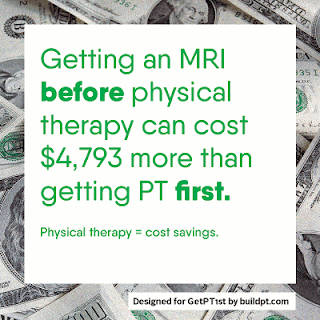

Getting an MRI before physical therapy can cost $4,793 more than getting PT first. Physical therapy = cost savings.


Furthermore, multiple research studies have agreed on the benefits of direct access. A study from Georgetown and Johns Hopkins University found that the total paid averaged $2236 for “physician referral” episodes of physical therapy as compared to $1004 for “direct access” episodes of physical therapy. Additionally, the physician referral episodes were 65% longer in duration than the direct access episodes. A similar study from the Journal of Health Services Research analyzed patients with low back pain. Those who saw a physical therapist at the first point of care had an 89% lower probability of having an opioid prescription and a 28% lower probability of having any advanced imaging services. The pattern is clear - lower cost, quicker improvement, and positive outcomes.

Direct access for physical therapy in Illinois has been a long time in the making, and has only been made possible through the expense, time, energy and effort on the part of physical therapists and physical therapy advocates throughout the U.S.to finally allow consumers (like you!) prompt access to physical therapy services.  We are confident that, with fewer barriers, our patients will choose P.T. first! 

Call to Action:
Spread the word!  

At Lakeshore Physical Therapy, we are honored when our patients exercise their right to direct access care from our experienced physical therapists that are fully invested in their progress.

Resources:
Denniger T. et al. (2017). The Influence of Patient Choice of First Provider on Costs and Outcomes: Analysis From a Physical Therapy Patient Registry. Journal of Orthopaedic & Sports Physical Therapy, 2017, Volume:48 Issue:2 Pages:63-71 doi: 10.2519/jospt.2018.7423

Mitchell J. (1997). A Comparison of Resource Use and Cost in Direct Access Versus Physician Referral Episodes of Physical Therapy. Physical Therapy, Volume 77, Issue 1, 1 January 1997, Pages 10–18, doi.org/10.1093/pti/77.1.10

Frogner B. (2018). Physical Therapy as the First Point of Care to Treat Low Back Pain: An Instrumental Variables Approach to Estimate Impact on Opioid Prescription, Health Care Utilization, and Costs. Health Services Research, 2018 Dec;53(6):4629-4646. doi: 10.1111/1475-6773.12984. Epub 2018 May 23.

Tuesday, October 8, 2019

Happy National Physical Therapy Month!

As the weather cools in the fall, it’s tempting to be less physically active. October is the perfect time to stay focused on healthy self-care because we’re celebrating National Physical Therapy Month! Find new ways to get your body moving. Whether you’ve felt intimidated by yoga, you’ve always wanted to play tennis, or you’re finally ready to sign up for that 5K race, this month may be the perfect time to push yourself just a little out of your comfort zone. Your physical therapists at Lakeshore Physical Therapy are here to support you!


Choose more movement. Choose better health. Choose physical therapy.

Tuesday, August 27, 2019

Getting Into a Pickle(ball)

by Sally Fansler, PT
Move over, tennis and golf – here comes pickleball! A new favorite pastime among Baby Boomers, this sport combines elements of badminton, tennis and ping-pong. In recent years, it has become popular with older adults because of the smaller court, lower net, and slower ball speed. The rules are fairly straightforward and easy to learn, so pickleball easily becomes a fun social activity. It can be played indoors or out, in singles or doubles.

Over the past decade, however, the pickleball craze is taking hold at all age levels. Teenagers often play it in their physical education classes, and it is showing up as an intramural sport on college campuses. According to the USA Pickleball Association (USAPA), the sport has seen a 650% increase in numbers over the past six years. On-site pickleball courts are now being built not only at many retirement communities, but also as part of community park districts. The equipment – wooden paddles and plastic, whiffle-type balls – is also affordable, making it accessible to be enjoyed by a wide range of people.


Here is the pickleball rule overview:
  • The serve must be underhand and below the waist—and it must be made at least one foot behind the baseline, struck diagonally crosscourt.  Only one serve attempt is allowed.
  • Only the team serving the ball is able to score points, which take place when the opposite side fails to return the ball or commits other faults, such as hitting the ball out of bounds. 
  • When the ball is served, the receiving team must let it bounce before returning, and then the serving team must let it bounce before returning, thus two bounces.
  • After the ball has bounced once in each team’s court, both teams may either volley the ball (hit the ball before it bounces) or play it off a bounce (ground stroke).
  • The two-bounce rule eliminates the serve and volley advantage and extends rallies.
  • With doubles, both players on the serving team have the opportunity to serve and score points until they commit a fault
  • Games normally go to 11 points, with the leading team needing to be 2 points ahead to win
Lakeshore Sport & Fitness in Chicago is planning an intro to pickleball class on Sundays in the fall of 2019. Please contact LPRacquet@LakeshoreSF.com for more information. The Chicago Park District is also growing their program and information on additional places to play can be found here: https://www.chicagoparkdistrict.com/taxonomy/term/2210

References:

Tuesday, July 23, 2019

Sciatica: One Pain, Many Causes

by Constance Taras, PT
Anyone who has ever experienced sciatica knows the feeling: a radiating pain or numbness that runs down the buttock, leg and even as far down as the calf and foot. So named because it is felt along the path of the sciatic nerve, sciatica is not a disorder in and of itself but rather a symptom that can be caused by many different pathologies including a herniated disc (Picture A), stenosis, SI dysfunction, piriformis spasm (Picture B), or core instability. Having the source of your pain be diagnosed is very important for proper treatment as not one size fits all!

         Picture A: Herniated disc                   Picture B: Piriformis spasm
The sciatic nerve is comprised of the nerves that come out of the lower lumbar spine (L4-S3 nerve roots), which group together, run through the buttock (most commonly through the piriformis muscle) and down the back of the leg all the way to the foot. Irritation to this nerve usually takes the form of tingling, numbness, or burning, but sciatica sufferers have also reported sharp or burning pain and weakness. 


For nerves to stay happy, they have to have enough of three main elements: movement, blood flow, and space. Addressing these factors help guide our treatment of nerve pain.

  • Increasing Movement: Nerves don’t really stretch, but we can perform glides to slide them along their track and keep them from adhering to surrounding tissues.
  • Increasing Blood Flow: Heat increases blood flow and is typically a good line of treatment for nerve injuries to promote healing. 
  • Increasing Space: We want to ensure there aren’t any structures compressing the nerve such as a bulging disc, a muscle in spasm, or narrowed vertebral foramen (bony space where the nerve exits the spinal column). A variety of manual techniques and self-stretches and exercises may be prescribed to improve the space around the nerve.

In more chronic or extreme cases, irritation or compression of a nerve can cause weakness to the affected muscle as nerves also innervate (or give “electrical power” to) muscles. The muscles most commonly affected by sciatic nerve injury are the hamstrings (which bend the knee), anterior tibialis (which can result in foot drop), calf, and other ankle/foot muscles. Weakness in any of these groups can result in decreased balance, difficulty with stairs and prolonged walking, and feeling like your leg is going to give out on you.

Understanding where your pain is coming from is the first step to recovery – then having it properly treated by a physical therapist is the next best step. At Lakeshore Physical Therapy we treat these type of injuries and pathologies all of the time. We feel confident that we can identify the source of your sciatica and quickly get you pain-free!


Check out our recent Instagram post @lakeshorephysicaltherapy to see videos of some suggested exercises to treat your nerve pain!

Wednesday, June 19, 2019

Elbow Pain, Could the Shoulder be to Blame?

by Julia Glick, PT
As therapists in a clinic located inside of a large tennis club, we are seldom surprised when a number of our patients each year present with lateral epicondylitis – or, as it is more commonly known, tennis elbow. Lateral epicondylitis pain usually occurs over the outside of the elbow where many of the forearm muscles attach, an area that experiences a lot of strain in tennis. However, even those of us who aren’t on the courts every week should be aware of it: it is also common in people who spend a lot of time at the computer or perform lots of gripping during their day. 

Despite the fact that lateral epicondylitis pain feels like it is centered in the elbow, it is important to look at the whole arm. Many people who come to us for tennis elbow have unsuccessfully tried exercises on their own that focus on the wrist and elbow, and are surprised when we turn our attention to the shoulder. Most specifically, the muscles that control shoulder blade position, such as the lower trapezius and serratus anterior, are crucial when treating the elbow, as the position of the whole arm is determined by the orientation of the shoulder blade. 

In fact, several research articles have come out in the past few years that focus on the role weakened shoulder blade stabilizers plays in lateral epicondylitis. Lucado et al. and Day et al. found that people with lateral epicondylitis had significantly weaker lower trapezius and serratus anterior musculature than people without any lateral elbow pain. In a case study performed by Bhatt et al., the research team only treated a woman’s shoulder blade stabilizers and were able to resolve her lateral epicondylitis. Essentially, these studies agree that the muscles that help pull the shoulder blade back and keep it stable also control the position of the arm and elbow: when it comes to prevention of elbow pain, shoulder blade strength and position matters.

Interested in finding some exercises that target the lower trapezius and serratus anterior to help maintain the shoulder blade in its optimal back position? I’ve included some below:

Easier Lower Trapezius
Lie on stomach and roll up a small towel under forehead and place hands on back of head/neck. Squeeze shoulder blades back and down toward opposite pants pocket and lift up elbows. Hold for 5 seconds and perform 5-10 repetitions.


Harder Lower Trapezius (Y)
Lie on stomach and roll up a small towel under forehead. Lift your arms up so they make a “Y” shape. Squeeze your shoulder blades back and down toward opposite pants pocket and lift your arms. Hold for 5 seconds and perform 5-10 repetitions. 


Serratus Anterior Wall Slides
Put your forearms on the wall and push your shoulder blades apart and into the wall. Keep this pressure into the wall and slide your arms up and down. Perform 5-10 repetitions.


Try these exercises and let us know what you think! If you do have pain that is persistent, please stop by to speak with one of our skilled clinicians, who can help you with your injury.

Resources: 
Bhatt, J., Glaser, R., Chavez, A., & Yung, E. (2013). Middle and Lower Trapezius Strengthening for the Management of Lateral Epicondylalgia: A Case Report. Journal Of Orthopaedic & Sports Physical Therapy43(11), 841-847. doi: 10.2519/jospt.2013.4659

Day, J., Bush, H., Nitz, A., & Uhl, T. (2015). Scapular Muscle Performance in Individuals With Lateral Epicondylalgia. Journal Of Orthopaedic & Sports Physical Therapy45(5), 414-424. doi: 10.2519/jospt.2015.5290

Lucado, A., Kolber, M., Cheng, M., & Echternach, J. (2012). Upper Extremity Strength Characteristics in Female Recreational Tennis Players With and Without Lateral Epicondylalgia. Journal Of Orthopaedic & Sports Physical Therapy42(12), 1025-1031. doi: 10.2519/jospt.2012.4095

Friday, May 3, 2019

Growing Good Body Mechanics in the Garden

by Lauren Sweeney, Office Manager
Of all the places I like to spend time in the late spring and early summer, my garden is one of my favorites. Now that we've braved our last gasp of snow in Chicago (fingers crossed!), I'm ready to uncover my raised beds, turn my compost and get my seedlings started. In all the excitement of getting to grow things, though, it can be easy to forget to be good to our best gardening tools: our bodies. We often don't realize how hard we've worked outside until we're struggling to get out of bed the next morning.

At its core, gardening is no different than any other kind of exercise: it requires movement in multiple planes of motion, and can put strain on the knees and the back. As such, a warmup prior to gardening - a quick walk around the block, some stretches - can help prevent soreness later. As you are gardening, think about how your body is feeling: have you been crouching for a while? Doing a repetitive motion? If you find you're getting sore in one position or during one activity, change your body position or take a break. It can be tempting to plant those last five tomatoes and just be done, but switching to shoveling mulch or taking a water break can give your body the change it needs to get the job done.

Two hands in brightly-patterned gloves using a trowel to plant a red and yellow flower in the dirt

As most gardening is done on the ground, knees can suffer. If you will be spending a while in a kneeling position, consider knee pads or a gardening pad to reduce pressure. If kneeling is difficult, a bucket or low chair can allow you to plant from a seated position. Gardening using raised beds can help reduce strain as well, as they do not require the gardener to get quite as low to the ground, and when shoveling or raking, be sure to keep knees soft (rather than locked).

Many gardening tasks also require a lot of our core and our backs, so it is important to be mindful of them. When moving heavy materials, such as stone or bags of mulch or soil, be sure to use proper lifting mechanics (bending from the hips, turning feet to move loads rather than twisting or lifting). If something is too difficult to lift alone, use a wheelbarrow or ask someone for help. Try not to overload shovels or trowels, and use a hose for watering instead of lugging around a watering can, especially for hanging plants.

When you are done for the day, finish up with some light stretching. And don't forget to take breaks for food and water! It is easy to misjudge the amount of work we have been doing when we are engaged in a task like gardening. If you do experience a new pain working outside, don't hesitate to stop in our office - we'd be happy to help you get back to enjoying your garden.

Resources:
https://www.moveforwardpt.com/Resources/Detail/gardening
http://www.rehab.msu.edu/wellness/garden.html 

Monday, April 8, 2019

Ice versus Heat: A Hot (or Cold) Topic


by Constance Taras, PT
One of the questions we most commonly field when patients have first sustained an injury is “Should I ice it, or would heat be better?” Both heat and ice are conservative, beneficial modalities, but to better understand the benefits of either, let’s first look at the physiological effects of each:


Typically, the more traditional approach is to apply ice to musculoskeletal injuries, but the type of musculoskeletal injury is important. For acute injuries that are swollen, warm, and painful (such as ankle sprains), ice can temporarily numb the area and decrease pain signals from the nerves, therefore decreasing pain. Ice also constricts the surrounding blood vessels so that less fluid and fewer cells arrive at the injured area. While this could theoretically slow down healing to the area as it does restrict the flow of healing mediator cells (leukocytes) to the area, it also means that less swelling is present. Less pressure on all the surrounding structures could mean less pain and improved range of motion.

However, what if we are dealing with a more chronic injury? Chronic injuries often suffer from decreased blood flow to the injured area, and as a result have a harder time healing. Application of heat, therefore, is the more beneficial modality, as it increases the rate that blood and repairing cells reach the injured site to improve the overall healing process. We also tend to recommend heat over ice in the case of a muscle in spasm or a tight muscle: the improved tissue extensibility provided by heat helps to relax shortened and tensed muscles in order to decrease spam and ultimately pain. Heat also allows improved stretching and increased range of motion, whereas ice could cause the muscle to tighten further, decreasing range of motion at a joint.

But an equally important factor to consider is how heat or ice makes you feel! If ice makes your pain worse or vice versa then it may not be the best option for you, even if clinically it makes more sense (unless it is contraindicated by other health conditions, such as diabetes, Raynaud’s disease or hypertension). If you are unsure what is the best modality for you and your specific injury, reach out to a Lakeshore physical therapist to help you build a customized plan!

References:
Malanga et. al. Mechanisms and efficacy of heat and cold therapies for musculoskelatal injury. Postgrad Med 2015; Early Online 1-9.